
 816-400-4477
Summary Of Health Insurance Options for Families
Securing the best health insurance for families requires balancing your monthly budget against your potential medical needs. Whether you prioritize the massive nationwide network of Blue Cross Blue Shield, the technological convenience of UnitedHealthcare, or the comprehensive localized care of Kaiser Permanente, there is a plan out there tailored to your household.
Take advantage of the health insurance options under healthcare reform by thoroughly exploring your eligibility for premium tax credits. By understanding the differences between HMOs and PPOs, keeping track of enrollment deadlines, and prioritizing your family’s specific medical must-haves, you can confidently navigate the United States health insurance providers and ensure your loved ones are protected for whatever the future holds.
Quick Links:
Understanding Health Insurance Options Under Healthcare Reform
How We Chose the Best Health Insurance for Young Families
The 10 Best US Health Insurance Options for Families
Decoding Family Health Insurance Plans: HMO vs. PPO vs. EPO
How To Find Health Insurance For Your Family
Finding the right health insurance for families can feel like navigating a maze blindfolded. Between deciphering medical jargon, calculating premiums versus out-of-pocket costs, and ensuring your preferred pediatrician is in-network, the process is notoriously overwhelming. However, securing comprehensive, affordable coverage is one of the most critical steps you can take to protect your family’s physical and financial well-being.
Whether you are a growing family preparing for a new baby, an established household managing chronic conditions, or healthy parents simply looking for the best “just-in-case” coverage, you need a plan that works when you need it most.
In this comprehensive guide, we will break down the top United States health insurance providers, explain your health insurance options under healthcare reform, and provide a step-by-step guide to enrolling family in health insurance without the headache.

Understanding Health Insurance Options Under Healthcare Reform
When searching for the perfect plan, it is crucial to understand your health insurance options under healthcare reform. The Affordable Care Act (ACA), often referred to as Obamacare, fundamentally changed the landscape of family health insurance plans by establishing consumer protections and standardizing coverage.
Because of the ACA, all marketplace plans must cover ten “Essential Health Benefits.” For families, this is a game-changer. These essential benefits include:
- Pediatric services (including oral and vision care for children)
- Maternity and newborn care
- Emergency services
- Hospitalization
- Prescription drugs
- Preventive and wellness services (like vaccines and annual checkups at no out-of-pocket cost)
- Mental health and substance use disorder services
Furthermore, healthcare reform introduced Premium Tax Credits (PTCs). These subsidies lower the monthly premium costs for eligible families based on household size and income. Thanks to recent legislative updates extending enhanced subsidies, more middle-class families than ever qualify for significant financial assistance, making comprehensive individual health insurance options highly affordable.
The Metal Tiers Explained
When shopping the ACA Marketplace, you will see plans categorized by metal tiers. These do not reflect the quality of care, but rather how you and the insurance company split the costs:
- Bronze: Lowest monthly premiums, highest deductibles. Best for very healthy families who only need emergency protection.
- Silver: Moderate premiums and deductibles. Crucially, Silver plans are the only tier where you can qualify for Cost-Sharing Reductions (CSRs), which lower your deductibles, copays, and out-of-pocket maximums based on income.
- Gold: Higher monthly premiums, lower out-of-pocket costs. Great for families who visit the doctor frequently or have regular prescription needs.
- Platinum: Highest monthly premiums, lowest out-of-pocket costs. Ideal for families with known, extensive medical needs.
How We Chose the Best Health Insurance for Young Families
When evaluating the market for the best health insurance for young families, we didn’t just look at the price tag. Young families need flexibility, robust pediatric networks, and modern conveniences. We evaluated the top United States health insurance providers based on the following criteria:
- Network Size and Quality: Does the provider have a wide selection of top-rated pediatricians, OB-GYNs, and family practice doctors?
- Affordability & Value: We looked at premium costs, deductible structures, and the availability of subsidized marketplace plans.
- Telehealth Capabilities: Parents don’t always have time to drag a sick toddler into a waiting room. Robust, 24/7 virtual care options are mandatory.
- Maternity & Pediatric Support: We prioritized companies offering healthy pregnancy programs, lactation support, and comprehensive pediatric benefits.
- Digital Experience: A user-friendly app for tracking claims, finding doctors, and accessing digital ID cards is essential for busy parents.
The 10 Best US Health Insurance Options for Families
Based on our rigorous criteria, here is our roundup of the 10 best family health insurance plans available in the US today.
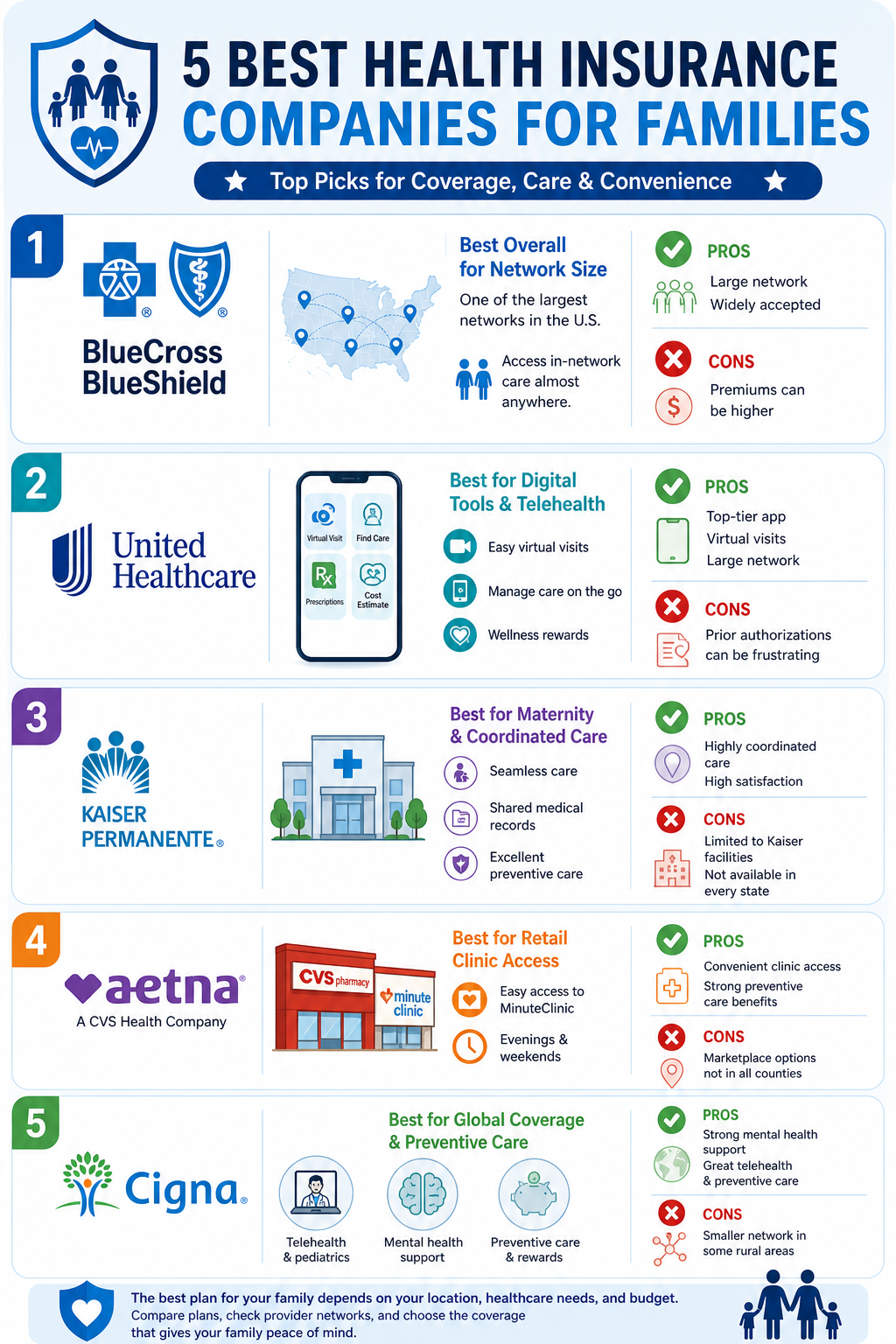
1. Blue Cross Blue Shield (BCBS)
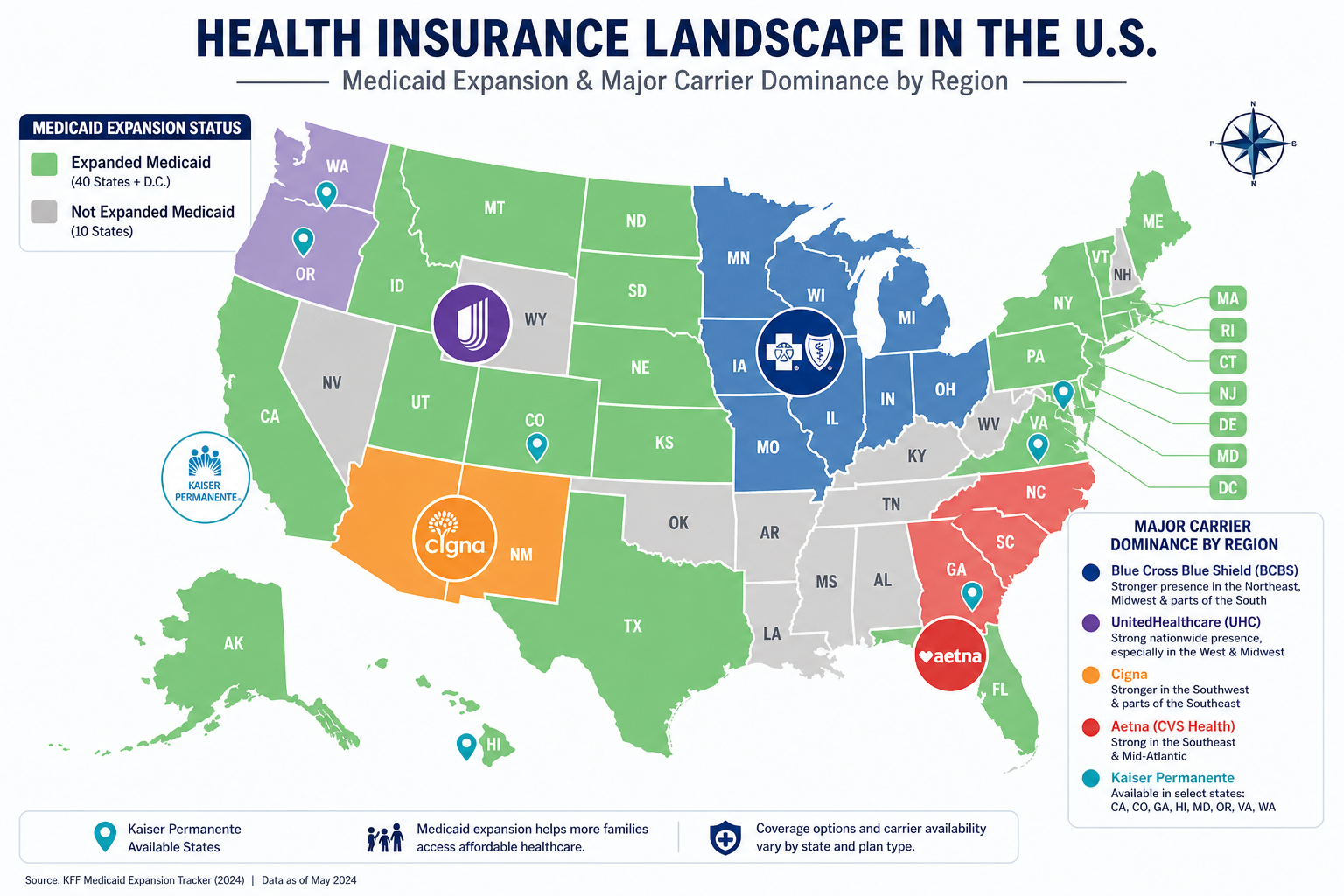
Best Overall for Network Size Blue Cross Blue Shield is a titan in the health insurance industry, operating as a federation of 34 independent, locally operated companies.
- Why it’s great for families: BCBS boasts one of the largest provider networks in the country. If you travel frequently or have children heading off to an out-of-state college, BCBS’s BlueCard program allows you to access in-network care almost anywhere in the US.
- Pros: Massive nationwide network, highly accepted by specialists, excellent employer-sponsored and individual marketplace options.
- Cons: Premiums can be higher than regional competitors.
2. UnitedHealthcare (UHC)
Best for Digital Tools and Telehealth UnitedHealthcare is the largest single health carrier in the United States. They have invested heavily in technology to make managing healthcare easier.
- Why it’s great for families: UHC’s digital tools are unmatched. Their app allows parents to easily schedule virtual visits, estimate costs for upcoming procedures, and manage prescriptions. Their “Rally” wellness program also offers financial rewards for hitting health milestones.
- Pros: Top-tier mobile app, free 24/7 virtual visits on many plans, massive national network.
- Cons: Navigating prior authorizations can sometimes be frustrating.
3. Kaiser Permanente
Best for Maternity and Coordinated Care Kaiser Permanente operates on a unique model: they are both the insurer and the healthcare provider. You visit Kaiser facilities and see Kaiser doctors.
- Why it’s great for families: This HMO model results in incredibly seamless care. Your pediatrician, pharmacy, lab, and specialists are often in the same building, and they all share one electronic medical record. This is highly regarded as one of the best health insurance for young families expecting a baby, as their maternity care coordination is stellar.
- Pros: Exceptional preventive care, highly coordinated treatment, high customer satisfaction.
- Cons: Strictly limited to Kaiser facilities; only available in certain states (e.g., CA, CO, GA, HI, MD, OR, VA, WA).
4. Aetna (CVS Health)
Best for Retail Clinic Access Since being acquired by CVS Health, Aetna has deeply integrated its insurance plans with CVS Pharmacy and MinuteClinic locations.
- Why it’s great for families: Kids get sick at the most inconvenient times. Aetna members often get zero-dollar or low-cost access to MinuteClinics for minor illnesses (like strep throat or ear infections) on evenings and weekends without needing to visit an expensive urgent care or ER.
- Pros: Unbeatable convenience with CVS MinuteClinic integration, strong preventative care benefits.
- Cons: Marketplace ACA options are still growing and may not be available in all counties.
5. Cigna
Best for Global/Travel Coverage and Preventive Care Cigna is known for its excellent global reach and focus on preventive, whole-person health.
- Why it’s great for families: Cigna offers robust telehealth options through MDLive, including access to board-certified pediatricians and licensed therapists. They also offer excellent health rewards programs and predictable, low copays for generic maintenance medications.
- Pros: Strong mental health support, excellent telehealth integration, comprehensive preventive services.
- Cons: Provider network is slightly smaller than BCBS or UHC in some rural areas.
6. Ambetter (Centene)
Best for Budget-Conscious ACA Shoppers Ambetter specializes entirely in ACA Marketplace plans and is the largest provider of such plans in the country.
- Why it’s great for families: If you are buying your own insurance and looking for the most affordable health insurance options under healthcare reform, Ambetter frequently offers the lowest-cost Silver and Bronze plans. They also include a “My Health Pays” program where families can earn reward dollars to help pay for premiums or utility bills.
- Pros: Very affordable premiums, great rewards program, widely available on the state and federal exchanges.
- Cons: Narrower networks; you must verify your preferred pediatrician is in-network.
7. Oscar Health
Best for Tech-Savvy Young Families Oscar Health was built for the modern era, focusing entirely on a simplified, tech-forward user experience.
- Why it’s great for families: Oscar makes healthcare easy to understand. They offer 24/7 virtual urgent care at $0 on most plans, and every family gets a dedicated “Care Team” (a nurse and care guides) to help you find doctors and understand bills.
- Pros: Beautiful, intuitive app; dedicated concierge care team; free virtual urgent care.
Cons: Smaller provider networks; not available in all states.
8. Anthem (Elevance Health)
Best for Regional Reliability Anthem operates Blue Cross Blue Shield plans in 14 states, making it a massive regional powerhouse.
- Why it’s great for families: Anthem combines the massive network benefits of the BCBS brand with innovative local programs. They offer robust maternal health programs, including the “Future Moms” program, which provides 24/7 access to obstetrical nurses during pregnancy.
- Pros: Excellent maternal programs, deep local networks, strong dental and vision add-ons.
- Cons: Customer service experiences can vary significantly by state.
9. Molina Healthcare
Best for Transitioning from Medicaid Molina Healthcare focuses primarily on government-sponsored healthcare programs, including Medicaid, Medicare, and the ACA Marketplace.
- Why it’s great for families: If your family’s income fluctuates and you occasionally transition between Medicaid and marketplace plans, Molina makes this process incredibly smooth, often allowing you to keep the same doctors across both plan types.
- Pros: Low premiums, excellent integration with state Medicaid programs, covers essential family health basics well.
- Cons: Very strict HMO networks; customer support wait times can be long.
10. CHIP (Children’s Health Insurance Program) & Medicaid
Best for Low-Income Families While not a private company, state-run Medicaid and CHIP programs are the absolute best option for eligible families.
- Why it’s great for families: If your household income qualifies, these programs provide comprehensive health insurance for families at little to no cost. CHIP specifically covers children in families that earn too much to qualify for Medicaid but cannot afford private insurance. They cover routine check-ups, immunizations, doctor visits, prescriptions, dental, and vision care.
- Pros: Unbeatable affordability, comprehensive pediatric coverage.
- Cons: Subject to strict income eligibility limits; fewer private practice specialists accept Medicaid compared to commercial insurance.
Decoding Family Health Insurance Plans: HMO vs. PPO vs. EPO
Before pulling the trigger on a plan, it is vital to understand the network structure. The letters attached to individual health insurance options (HMO, PPO, EPO) dictate which doctors you can see and how much you will pay.
Health Maintenance Organization (HMO)
HMOs require you to choose a Primary Care Physician (PCP). Your PCP acts as a gatekeeper; if your child needs to see an allergist or a dermatologist, you must get a referral from your PCP first. HMOs generally do not cover out-of-network care except in true emergencies.
- Family Fit: Best for families looking to save money on premiums and who don’t mind coordinated, centralized care.
Preferred Provider Organization (PPO)
PPOs offer the most flexibility. You do not need a primary care doctor, and you do not need referrals to see specialists. You can also see out-of-network doctors, though you will pay more than if you stayed in-network.
- Family Fit: Best for families managing complex, chronic conditions that require multiple specialists, or families who travel frequently.
Exclusive Provider Organization (EPO)
An EPO is a hybrid. Like a PPO, you don’t need a referral to see a specialist. Like an HMO, however, there is strictly no out-of-network coverage (except for emergencies).
Family Fit: A great middle-ground for families who want the freedom to skip the PCP referral process but want lower premiums than a traditional PPO.
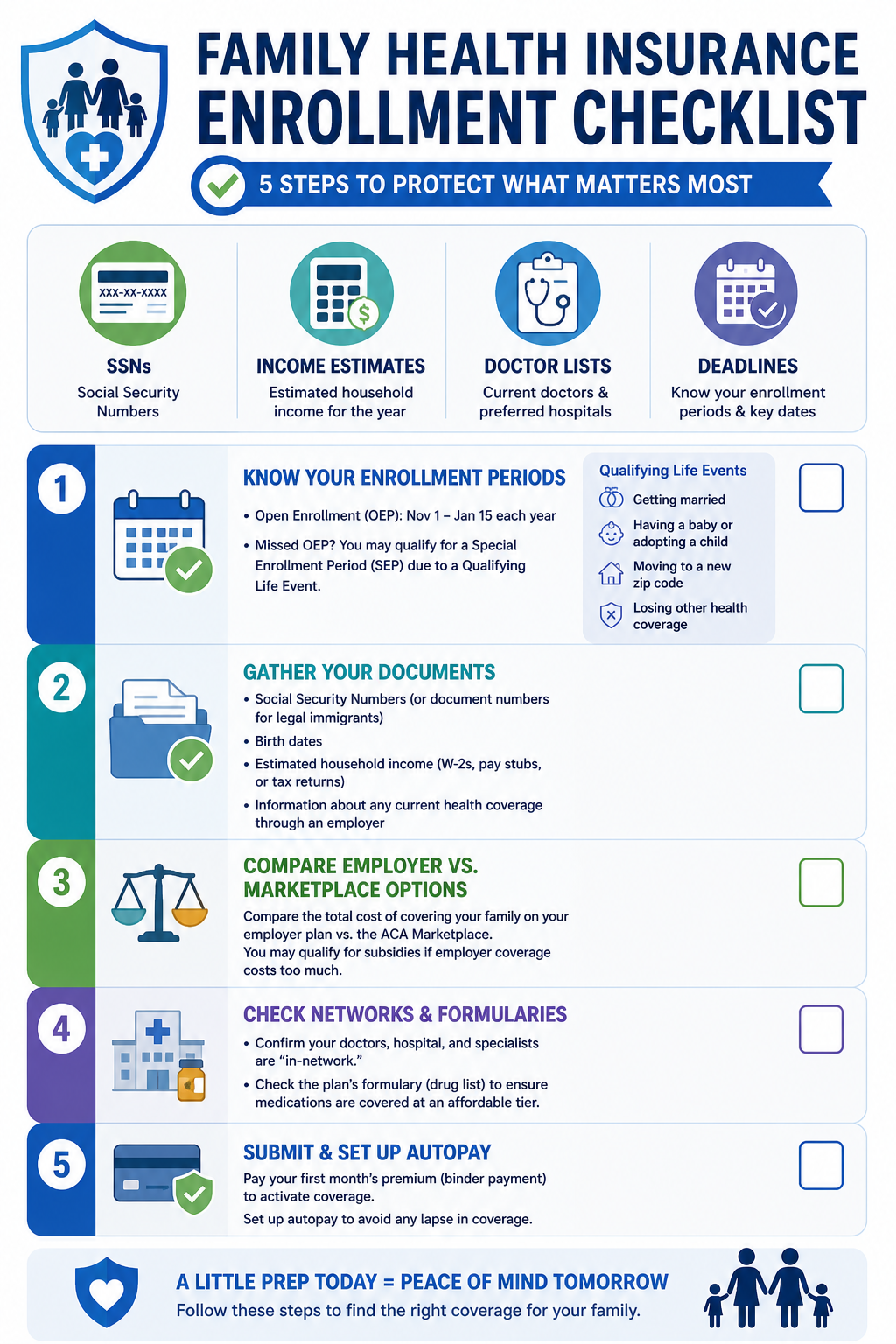
Step-by-Step Guide: Enrolling Family in Health Insurance
Enrolling family in health insurance doesn’t have to be a stressful ordeal. By preparing in advance, you can breeze through the application process.
Step 1: Know Your Enrollment Periods
You cannot buy health insurance at just any time of the year. You must purchase during the Open Enrollment Period (OEP). For the federal marketplace (Healthcare.gov), OEP typically runs from November 1st to January 15th each year.
If you miss this window, you can only enroll if you qualify for a Special Enrollment Period (SEP). SEPs are triggered by Qualifying Life Events, which are very common for young families. These include:
- Getting married
- Having a baby or adopting a child
- Moving to a new zip code
- Losing other health coverage (e.g., leaving a job)
Step 2: Gather Your Documents
Before you sit down to apply, gather the necessary documentation for every family member you intend to cover:
- Social Security Numbers (or document numbers for legal immigrants)
- Birth dates
- Estimated household income for the upcoming year (W-2s, pay stubs, or tax returns)
- Information about any current health coverage you or your spouse may have through an employer.
Step 3: Compare Employer vs. Marketplace Options
If one or both parents have access to employer-sponsored insurance, you must compare it to the Marketplace. Historically, some families faced the “family glitch,” where an employer offered affordable coverage for the employee, but exorbitant premiums to add a spouse and kids. Recent healthcare reform fixed this glitch. Now, if the cost to cover the whole family on an employer plan exceeds a certain percentage of your household income, your family can qualify for subsidies on the ACA Marketplace. Always run the math on both!
Step 4: Check the Networks and Formularies
Before hitting “buy,” do a quick search on the insurer’s website. Ensure your current pediatrician, preferred local hospital, and any necessary specialists are “in-network.” Next, check the plan’s “formulary” (drug list) to ensure any daily medications your family takes are covered at an affordable tier.
Step 5: Submit and Set Up Autopay
Once you enroll, your coverage is not officially active until you pay your first month’s premium (the “binder payment”). Set up autopay immediately so you never risk a lapse in coverage due to a missed bill.
Frequently Asked Questions (FAQs)
Can I keep my adult children on my family health insurance plan? Yes. Under the Affordable Care Act, young adults can stay on their parents’ health insurance plan until they turn 26. This applies even if they are married, not living with you, not financially dependent on you, or eligible to enroll in their own employer’s plan.
What is the difference between individual health insurance options and family plans? Structurally, they are the same policies. The difference is simply who is covered. A family plan has a higher premium, a higher family deductible, and a higher out-of-pocket maximum than an individual plan. Once the family out-of-pocket maximum is reached, the insurer pays 100% of covered services for all family members for the rest of the year.
Are pediatric dental and vision covered? Under ACA marketplace rules, pediatric dental and vision care are considered Essential Health Benefits. This means they must be available to you. Sometimes they are embedded directly into the medical plan; other times, they are offered as a stand-alone plan you must purchase alongside your medical plan. Be sure to check the specific details of the plan you choose.
How do I know if my family qualifies for Medicaid or CHIP? Eligibility varies by state and is based on your household income and family size. You can apply at any time of the year (there is no Open Enrollment restriction for Medicaid/CHIP). The easiest way to check is to fill out an application on Healthcare.gov; the system will automatically route your application to your state’s Medicaid agency if it appears your family qualifies.
Disclaimer: Health insurance markets, premiums, and regulations are subject to change. Always review plan details, network directories, and official state/federal exchange documentation before making financial decisions regarding your family health insurance plans.

I am a professional content writer specializing in the health insurance field. My work primarily focuses on simplifying the complexities of healthcare coverage, aiming to provide clarity and insight into an often confusing subject. Empowering people to make informed decisions about their well-being is my passion. At Apollo Health Insurance, we share that commitment. Apollo Health Insurance stands at the forefront of securing the best healthcare coverage for individuals, ensuring affordability without compromising on quality.