
 816-400-4477

Navigating health insurance can feel like a puzzle where the pieces change shape every year. If you're shopping for family coverage in 2026, the landscape looks noticeably different — here's exactly what changed, and what's stayed the same.
The short version
ACA family coverage in 2026 still runs on the same core protections it always has: every Marketplace plan must cover essential health benefits, no family member can be denied coverage for a pre-existing condition, and preventive care for kids is free. What's changed is the enrollment calendar and the subsidy math. The temporary, enhanced premium tax credits expired at the end of 2025, the special year-round enrollment window for households under 150% of the federal poverty level has been eliminated, and the 2023 "family glitch" fix remains in place using an updated 9.96% affordability threshold for 2026. This guide breaks down everything from enrolling your kids to maximizing your tax credits.
Sources: 2025 HHS Federal Poverty Guidelines (used for 2026 Marketplace subsidy determinations); IRS Revenue Procedure 2025-25 (2026 ACA affordability percentage).
The core of ACA family coverage: what hasn't changed
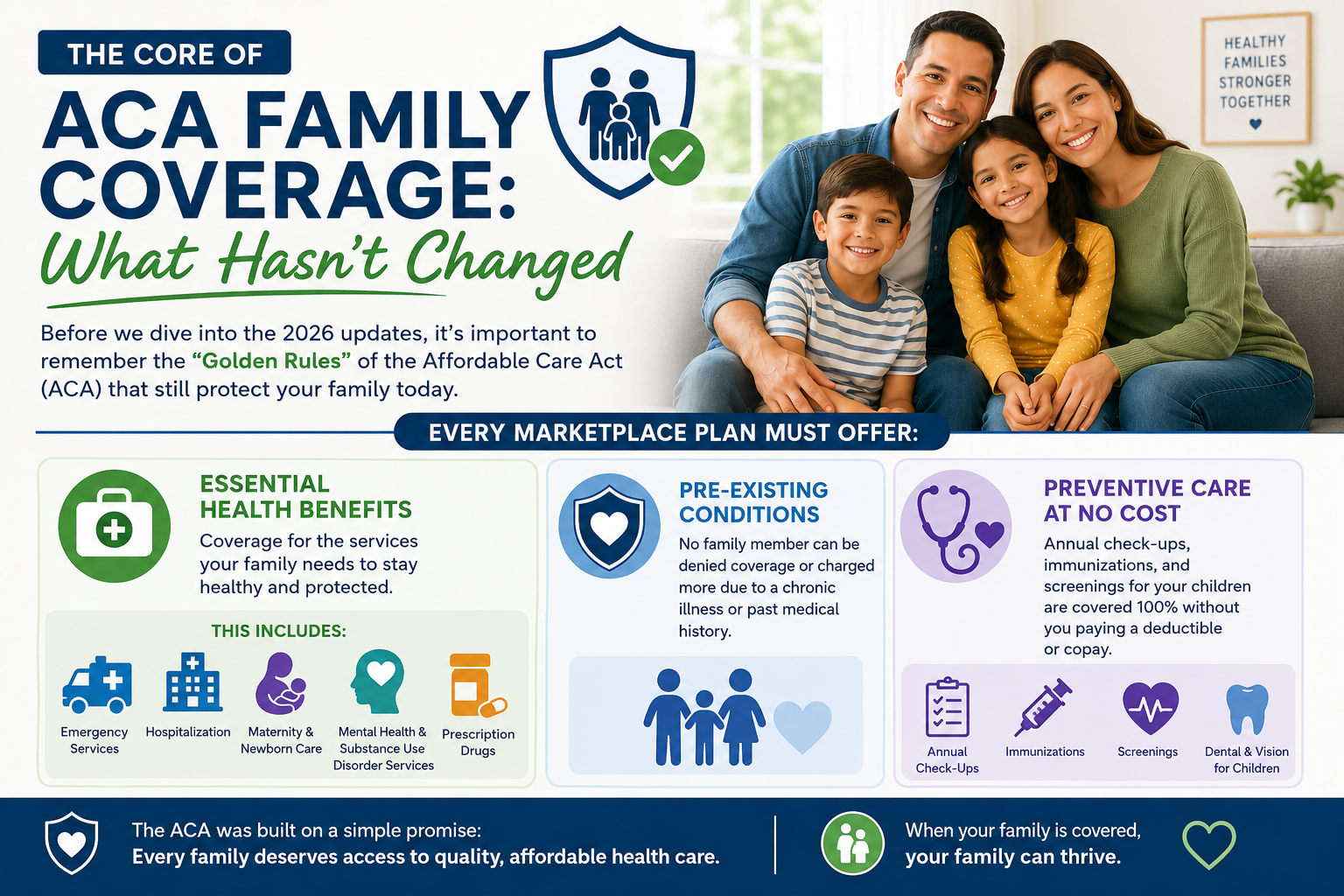
Before diving into the 2026 updates, it's worth remembering the protections that still apply to every family today, regardless of which insurance provider you choose. Every ACA Marketplace plan must offer:
- Essential health benefits: coverage for emergency services, hospitalization, maternity and newborn care, mental health, and prescription drugs.
- Pre-existing condition protection: no family member can be denied coverage or charged more due to a chronic illness or past medical history.
- Preventive care at no cost: annual checkups, immunizations, and screenings for your children are covered 100%, without a deductible or copay, when you use an in-network provider.
These three protections haven't changed since the ACA took effect, and they apply equally whether your family buys an on-Marketplace or off-Marketplace ACA-compliant plan.
Enrolling dependents: the age 26 rule in 2026
One of the most popular features of the ACA is the ability to keep adult children on a family plan. The rule remains consistent in 2026: children can stay on your plan until they turn 26.
- Marital status doesn't matter: your child can be married and still stay on your plan, though their spouse and any children of theirs cannot.
- Financial independence doesn't matter either: even if your 24-year-old has a full-time job or lives in another state, they're still eligible for your family coverage.
Understanding the 2026 metal tiers
When you browse the Marketplace, plans are organized into metal levels. These don't reflect the quality of care, but rather how costs are split between you and the insurance company.
| Metal level | Plan pays (avg) | You pay (avg) | Best for… |
|---|---|---|---|
| Bronze | ~60% | ~40% | Families who rarely see the doctor and want the lowest monthly premium |
| Silver | ~70% | ~30% | Families who qualify for Cost-Sharing Reductions ("Extra Savings") |
| Gold | ~80% | ~20% | Families with ongoing medical needs or high prescription costs |
| Platinum | ~90% | ~10% | Families who want almost no out-of-pocket costs at the doctor |
For most families, Silver plans are the sweet spot. They're the only tier eligible for Cost-Sharing Reductions (CSRs), which can lower your deductibles and copays significantly if your income falls within certain limits, generally up to 250% of the federal poverty level.
How premium tax credits work in 2026
The biggest question for 2026 is: can I still afford my premium? During the last few years, enhanced subsidies made plans very cheap, sometimes $0 a month. Entering 2026, those enhanced subsidies have sunset, so your premium tax credit is now calculated based on the original ACA structure.
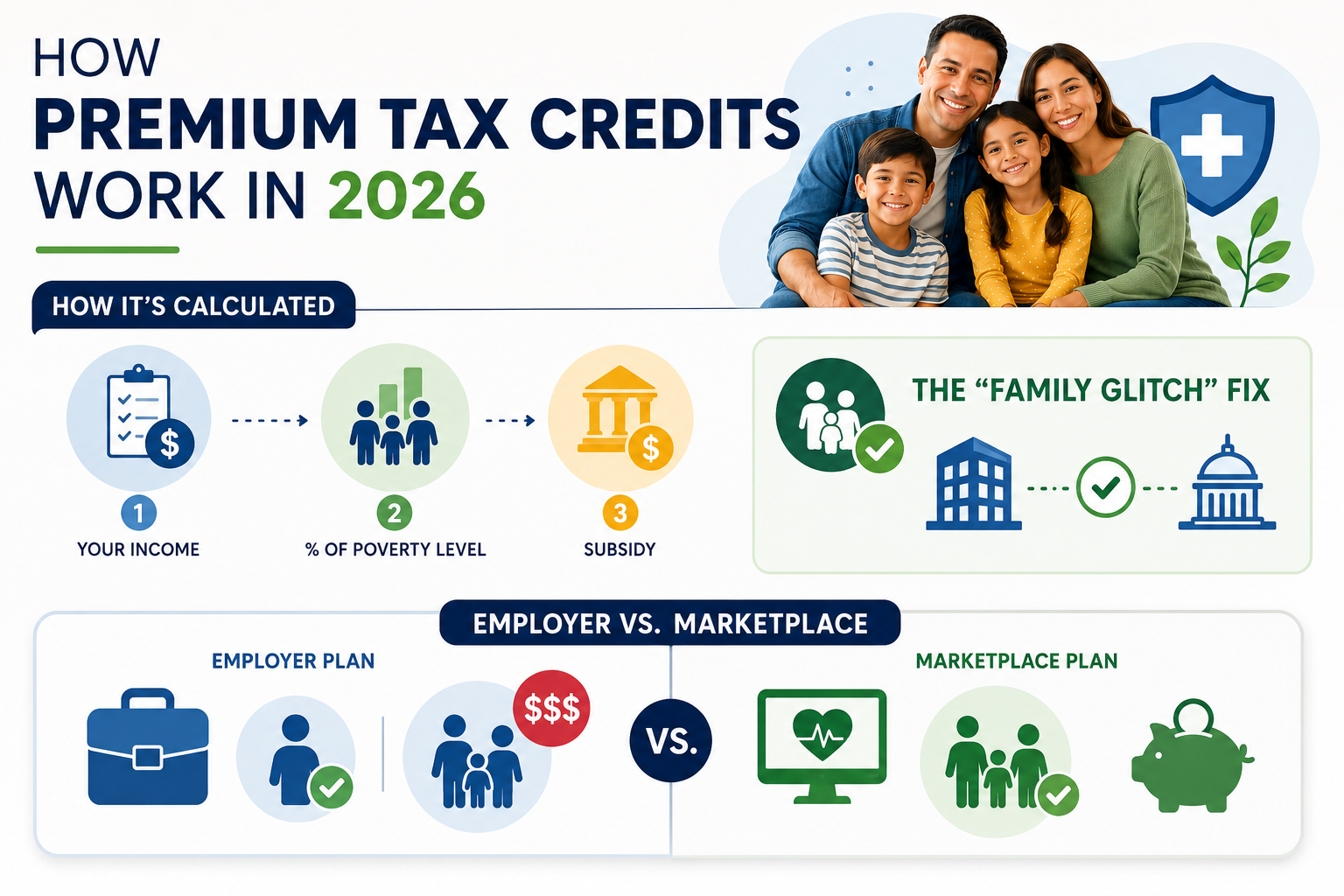
How it's calculated:
- Estimated household income: you report what you expect to earn in 2026.
- Federal Poverty Level (FPL): the government compares your income to the FPL for your family size.
- The subsidy: if your income is between 100% and 400% of the FPL, the government pays a portion of your premium directly to the insurance company.
Important deadlines for 2026 coverage
In 2026, the rules for when you can sign up have genuinely tightened. Open Enrollment generally runs from November 1 through January 15 in most states, though several states running their own exchange have adjusted their specific closing date. Miss this window, and you generally cannot sign up for the rest of the year unless you have a qualifying life event.
Special Enrollment Periods still apply if you:
- Get married or divorced.
- Have a baby or adopt a child.
- Lose other minimum essential coverage, such as losing a job.
- Move to a new ZIP code with different plan options available.
Choosing the best health insurance options
With so many health insurance providers, from major national carriers to smaller regional players, narrowing down the right plan for your family comes down to a few concrete steps. A licensed broker can walk through all three of these with you directly, rather than leaving your family to interpret plan comparison pages alone.
Step 1: check the network. Family health insurance is only useful if your pediatrician and preferred hospital are actually in-network. Before committing, use the Marketplace's search tool to filter plans by your specific doctors, rather than assuming a plan's general description covers them.
Step 2: calculate the total cost, not just the premium. A simple way to frame it: total annual cost equals twelve months of premium plus your estimated out-of-pocket costs for the year. If you have a child with asthma, or a family member who needs regular physical therapy, a Gold plan with a higher premium but lower copays might actually cost less by December than a cheaper-looking Bronze plan.
Step 3: consider an HSA-qualified plan. In 2026, many Bronze and Silver plans are HSA-qualified. A Health Savings Account allows you to set money aside pre-tax to pay for medical expenses. For 2026, the HSA contribution limit is $4,400 for individual coverage and $8,750 for family coverage. For a family of four, this can be a genuinely powerful way to lower your taxable income while building a dedicated safety net for braces, an emergency room visit, or another predictable-but-irregular family medical expense.
It's also worth remembering that pediatric dental and vision are required essential health benefits for children, but the same requirement doesn't automatically extend to the adults on the same family plan. Confirming whether your specific plan bundles pediatric dental and vision into the medical plan, or sells it as a required standalone companion policy, is worth doing before your child's first appointment of the year, rather than assuming it works the same way for every family member on the plan.
Common myths about ACA plans in 2026
Myth: "I make too much money to get a subsidy." Truth: while the enhanced subsidies have ended, many families making up to roughly $128,600, approximately 400% of the FPL for a family of four, still qualify for a meaningful tax credit under the base ACA formula.
Myth: "Marketplace plans are cheap insurance with worse doctors." Truth: ACA plans are offered by the same major insurance companies that provide employer-based coverage. The doctor networks frequently overlap significantly; the real difference is how the plan is purchased and who's paying the premium, not the underlying quality of care.

Checklist for 2026 family enrollment
- Estimate your 2026 household income as accurately as possible, to avoid owing money back at tax time.
- Verify your children's ages. If a child turns 26 this year, start planning for their transition to an individual plan well before December 31.
- Review your doctors and pharmacy. Insurance networks and formularies change every year; confirm your family's specialists and medications are still covered under the specific plan you're renewing or selecting.
- Re-run your family glitch math. The affordability threshold changed to 9.96% for 2026 — check this even if your family didn't qualify for a Marketplace subsidy last year.
- Apply during Open Enrollment. Mark your calendar for November 1, since the under-150% FPL year-round enrollment option no longer exists as a fallback.
For the authoritative federal sources on these rules, HealthCare.gov covers current Marketplace enrollment policy directly, the IRS publishes current premium tax credit guidance, and the Kaiser Family Foundation (KFF) tracks ongoing national subsidy and enrollment trends.
Common questions about ACA family coverage in 2026
Have a question that isn't answered below? Our full health insurance FAQ page covers more, and our blog has deeper guides on specific coverage topics.
Can my adult child stay on my family health plan?
Did ACA subsidies disappear in 2026?
What is the family glitch fix, and does it still apply in 2026?
Can low-income families still enroll in a Marketplace plan at any time of year?
Which metal tier is best for a family?
Does it cost more to use a broker to compare family ACA plans?
Let's find the right family coverage for 2026. At no cost.
An Apollo agent can re-check your family glitch eligibility under the new 2026 threshold, compare metal tiers against your household's actual healthcare needs, and confirm your pediatrician is in-network before you enroll.
Explore family health insurance quotes, or learn more about our licensed advisors.
Disclaimer: This guide is general educational information about ACA family health insurance coverage and is not insurance, tax, or legal advice. Subsidy amounts, affordability thresholds, and enrollment deadlines change annually and vary by state. Verify current details with HealthCare.gov, the IRS, or a licensed Apollo Health Insurance agent before making a coverage decision. Apollo Health Insurance is a licensed insurance brokerage; we are not affiliated with the federal government or any state agency.

I am a professional content writer specializing in the health insurance field. My work primarily focuses on simplifying the complexities of healthcare coverage, aiming to provide clarity and insight into an often confusing subject. Empowering people to make informed decisions about their well-being is my passion. At Apollo Health Insurance, we share that commitment. Apollo Health Insurance stands at the forefront of securing the best healthcare coverage for individuals, ensuring affordability without compromising on quality.