
 816-400-4477

Understanding how to manage health care costs is crucial for both employers and employees. An Individual Coverage Health Reimbursement Arrangement is one of the most flexible tools available — here's everything you need to know.
The short version
An ICHRA is an employer-funded health benefit that reimburses employees tax-free for individual health insurance premiums and qualified medical expenses. Instead of choosing a single group plan for everyone, the employer sets a defined monthly contribution, and each employee shops for and buys their own individual health insurance plan that fits their specific needs. The reimbursement is tax-free for the employee and tax-deductible for the employer, with no minimum participation or contribution requirements the way a traditional group plan often has. Since finalized federal rules took effect in 2020, ICHRA has become a genuine, fully compliant alternative to group coverage for employers of any size.

Sources: Final ICHRA regulations, U.S. Departments of Treasury, Labor, and Health and Human Services, effective 2020; Connecticut Public Act 26-68 (2026).
What is ICHRA and how does it work?
ICHRA is an employer-funded health benefit that reimburses employees tax-free for individual health insurance premiums. It's a modern alternative to group insurance, shifting the underlying risk from the group model back to the individual market's risk pool. Employers now offer a defined contribution instead of a defined benefit.
Employers set a monthly allowance, and employees purchase their own individual health insurance plans that meet minimum essential coverage guidelines, either on or off the ACA Marketplace. The employer then reimburses employees for their health insurance premiums, up to the allowance amount. The reimbursement is tax-free for employees and tax-deductible for employers. Through modern administration platforms, the entire process is considerably more streamlined to manage than a traditional group health plan's enrollment, billing, and renewal cycle.
Benefits of ICHRA for small businesses
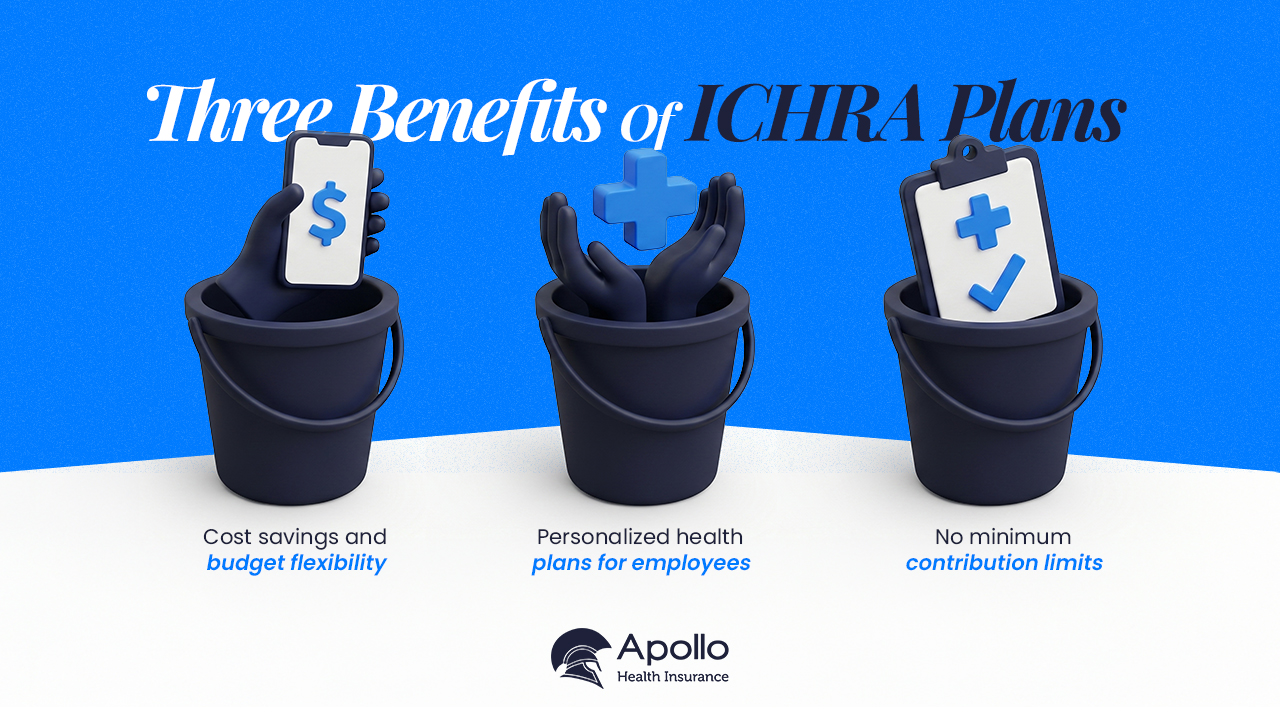
The biggest advantage for small businesses is that you set a fixed monthly budget and never pay more than that. There are no surprise premium increases mid-year and no risk of a bad claims year driving up costs the way a traditional group plan's renewal can. What you budget is what you spend, and there are no minimum participation or contribution requirements the way many group plans impose.
This approach eliminates the need to administer a traditional group health insurance plan, reducing administrative burden and compliance complexity. Additionally, ICHRA allows small businesses to tailor benefit levels to different employee classes, such as full-time versus part-time staff, or employees in different geographic locations, making it easier to meet a diverse workforce's needs while maintaining the tax advantages of employer contributions.
It's also worth understanding how ICHRA interacts with the ACA's employer shared responsibility rules for larger employers. An ICHRA can be structured to satisfy the ACA's employer mandate for applicable large employers, using a specific affordability safe harbor calculation based on the lowest-cost Silver plan in an employee's area, rather than the traditional group-plan affordability test. This is a genuinely technical calculation worth reviewing with a broker or benefits advisor rather than estimating on your own, since getting it wrong can carry a real penalty exposure for a larger employer.

Benefits of ICHRA for employees
The most popular aspect for employees is that instead of being locked into whatever single plan the employer selected, employees can shop for coverage that fits their specific needs: preferred doctors, specific networks, drug formularies, and deductible levels. It's personal health insurance, not a group compromise built around an average employee's needs. Additionally, the individual plan belongs to the employee, not the employer. If they leave the job, they keep the insurance, eliminating the costly burden of electing COBRA to continue coverage.
This arrangement helps employees manage out-of-pocket expenses more effectively and provides genuinely more control over their health care spending than a one-size-fits-all group plan typically allows. It's also worth understanding that if an employee's household income qualifies them for an ACA premium tax credit, accepting an ICHRA offer from an employer can affect that eligibility, since being offered "affordable" ICHRA coverage under the federal formula generally makes a household ineligible for a separate Marketplace subsidy. Checking this interaction specifically, rather than assuming an ICHRA offer and Marketplace subsidy eligibility can be combined freely, prevents a genuine surprise at tax time.
Tax benefits above and beyond
As discussed above, ICHRA benefits flow from the employer to the employee on a tax-free basis and are tax-deductible for the employer. This makes ICHRAs a highly efficient and cost-effective health benefit option for businesses of all sizes. Additionally, several states are recognizing the value of ICHRAs and have introduced supplemental tax credits to encourage businesses to adopt these plans.
Connecticut is a recent example: in 2026, the state passed Public Act 26-68, creating a tax credit of up to $1,000 per employee annually for eligible small businesses, those with 50 or fewer employees, that offer an ICHRA through the state's Access Health CT marketplace using its BusinessPlus platform. The credit is available for the first two consecutive years an employer offers an ICHRA, and the state has capped the program at $5 million annually, distributed on a first-come, first-served basis. Connecticut is the third state to pass this kind of ICHRA-specific incentive, reflecting a growing trend among states looking to reduce their uninsured rate by making employer-sponsored ICHRA adoption more attractive.
These state-level incentives further enhance the financial advantages of ICHRAs by reducing the overall cost burden on employers and promoting broader access to quality health coverage. Since state programs like this one are relatively new and specific to each state's own legislation, it's worth checking directly with your state's department of revenue or insurance marketplace to see whether a similar credit exists where your business operates, rather than assuming Connecticut's program is universal.
Enrollment and coverage period
When an employer offers an Individual Coverage Health Reimbursement Arrangement for the first time, it triggers a Special Enrollment Period for affected employees, regardless of the time of year the offering begins. This allows employees to select an individual plan and enroll promptly once the ICHRA offer starts, rather than waiting for the next annual Open Enrollment window.
In addition to this initial ICHRA enrollment trigger, standard Special Enrollment Periods remain applicable throughout the year. Life events such as relocation, marriage, or the birth of a child let employees change their individual plan to accommodate their evolving needs, the same way these events would for anyone shopping the individual market directly. These features make an ICHRA a genuinely more flexible ongoing arrangement than a traditional group health plan's single annual renewal cycle.
Employers considering an ICHRA also need to plan around a required notice period: current guidance generally calls for providing employees at least 90 days' advance written notice before a new ICHRA plan year begins, so that employees have adequate time to shop for and select an individual plan before their employer-sponsored coverage transitions. Building this notice requirement into your company's benefits calendar from the start avoids a rushed rollout that leaves employees scrambling to enroll.
ICHRA vs. traditional group plans
The core difference comes down to defined contribution versus defined benefit. A traditional group health plan is a defined benefit: the employer selects a specific plan design, and every enrolled employee gets that same plan, regardless of whether it fits their individual situation well. An ICHRA is a defined contribution: the employer sets a dollar amount, and each employee chooses whichever individual plan actually fits their own doctors, medications, and budget.
This difference cascades into several practical distinctions. Group plans typically require minimum participation thresholds and can face significant premium increases at renewal based on the group's claims experience; ICHRA contribution amounts are set by the employer and don't fluctuate with claims the way a group plan's renewal premium can. Group coverage generally ends when employment ends, often triggering COBRA; an ICHRA-funded individual plan belongs to the employee and continues regardless of employment status, as long as the employee continues paying for it themselves once the employer contribution stops.
Neither structure is universally better — a well-run traditional group plan can still make sense for certain workforces, particularly ones with strong buying power or specific benefit needs a single robust plan can meet efficiently. But for many small and mid-sized employers, the cost predictability and administrative simplicity of an ICHRA is a genuine and increasingly common alternative worth comparing directly against a group plan renewal quote before assuming group coverage is the default choice.
Getting your company's ICHRA set up right
Trying to navigate the health insurance world can be expensive and time-consuming, and ICHRA in particular involves genuine regulatory detail: correctly defining employee classes, calculating ACA affordability safe harbors for larger employers, meeting notice deadlines, and confirming which individual plans qualify for reimbursement. Getting these details right the first time avoids a costly correction later, and a broker experienced specifically with ICHRA administration can walk through each of these pieces methodically rather than leaving a business to interpret federal guidance on its own.
A quick checklist
- Define your employee classes clearly and document the contribution level for each class.
- Confirm whether your ICHRA design satisfies the ACA employer mandate's affordability safe harbor, if you're an applicable large employer.
- Build the required 90-day advance notice period into your benefits calendar for each new plan year.
- Confirm which individual plans qualify as minimum essential coverage for ICHRA reimbursement purposes.
- Check whether your state offers a supplemental ICHRA tax credit similar to Connecticut's program.
- Communicate clearly to employees how an ICHRA offer may affect their eligibility for a separate ACA premium tax credit.
- Compare your ICHRA cost projection directly against a traditional group plan renewal quote before deciding.
For the authoritative federal source on ICHRA rules, the U.S. Department of Labor publishes final ICHRA regulations directly, and current IRS guidance on employer health reimbursement arrangements is available through IRS.gov.
Common questions about ICHRA
Have a question that isn't answered below? Our full health insurance FAQ page covers more, and our blog has deeper guides on employer benefits topics.
What is an ICHRA?
When can I enroll in an ICHRA?
Does an ICHRA affect my eligibility for an ACA premium tax credit?
Is there a minimum contribution employers must make to offer an ICHRA?
What happens to my ICHRA-funded plan if I leave my job?
Does it cost more to work with a broker to set up an ICHRA?
Ready to explore ICHRA for your business? Let's talk. At no cost.
An Apollo ICHRA advisor can help define your employee classes, confirm ACA affordability compliance, and compare your ICHRA cost projection against a traditional group plan quote.
Explore ICHRA group benefits, or learn more about our licensed advisors.
Disclaimer: This guide is general educational information about Individual Coverage Health Reimbursement Arrangements and is not insurance, tax, or legal advice. ICHRA rules, state tax credit programs, and ACA compliance requirements vary and change over time. Verify current details with the U.S. Department of Labor, the IRS, your state's insurance department, or a licensed Apollo Health Insurance agent before implementing an ICHRA. Apollo Health Insurance is a licensed insurance brokerage; we are not affiliated with the federal government or any state agency.

I am a professional content writer specializing in the health insurance field. My work primarily focuses on simplifying the complexities of healthcare coverage, aiming to provide clarity and insight into an often confusing subject. Empowering people to make informed decisions about their well-being is my passion. At Apollo Health Insurance, we share that commitment. Apollo Health Insurance stands at the forefront of securing the best healthcare coverage for individuals, ensuring affordability without compromising on quality.