
 816-400-4477

Have you ever wondered how travel nurses manage their health insurance when they’re constantly on the move? It’s a question that comes up a lot, and for good reason. Unlike traditional nurses who work in one place, travel nurses face unique challenges when it comes to finding insurance coverage that keeps up with their ever-changing locations and assignments.
What happens if you switch states mid-contract? Or if there’s a gap between your assignments? Navigating these questions can feel overwhelming, but understanding what to look for in insurance coverage can make all the difference. Let’s dive into the essentials every travel nurse should know to stay protected, no matter where their career takes them.

What is Travel Nurse Health Insurance?
Let’s start with the basics! Travel nurse health insurance is a specialized form of health coverage tailored to meet the unique demands of nurses who take on temporary assignments in various locations, often spanning multiple states. Unlike traditional health insurance, which is typically linked to a single employer or geographic area, travel nurse health insurance emphasizes portability, flexibility, and broad network access. This ensures that nurses can access in-network care regardless of where their assignments lead them.
These plans feature nationwide or multi-state provider networks, accommodating the frequent relocations typical of travel nursing. They are designed to provide continuous coverage, minimizing gaps between assignments to protect nurses during transitions. Travel nurse health insurance also offers flexible plan options, allowing nurses to balance cost with comprehensive benefits according to their individual needs.

Core Health Insurance Options for Travel Nurses
Travel nurses generally have several health insurance options: agency provided health insurance (employer sponsored plans), individual plans purchased through the health insurance marketplace or state exchanges, private plans bought through specialized insurance brokers, and bridge solutions like short term health insurance.
What to look for will differ depending on whether you rely primarily on an agency plan or an individual health insurance plan. Many travel nurses mix options over a calendar year-using an agency plan during long contracts and switching to a marketplace plan when taking extended time off. Understanding these plan options sets the stage for every comparison that follows.
Travel nurses may also consider health sharing plans as an alternative to traditional health insurance. Health sharing plans are cooperative arrangements where members contribute monthly shares to cover each other’s eligible medical expenses, rather than paying premiums to an insurance company. These plans often emphasize community support, shared values, and cost savings, making them appealing for travel nurses who seek flexible, affordable coverage.
Health Sharing Plans for Travel Nurses
Health sharing plans offer an excellent alternative for travel nurses seeking flexible and affordable healthcare coverage. Unlike traditional insurance, these plans operate on a cooperative model where members share medical expenses, fostering a sense of community and shared responsibility. This structure often results in lower monthly costs and greater adaptability, making health sharing plans particularly well-suited for travel nurses who frequently move between assignments and states. We specialize in helping travel nurses navigate the complexities of enrolling in health sharing plans, providing expert guidance to ensure they find a plan that aligns with their unique lifestyle and healthcare needs. By offering personalized support, we make it easier for travel nurses to secure continuous coverage that travels with them, providing peace of mind and financial protection throughout their careers.
What to Check Before You Enroll
Most travel nursing agencies offer employer-sponsored health insurance options, typically including medical coverage with dental and vision benefits available as add-ons. These plans often kick in after a waiting period of 1 to 30 days. However, some agencies only provide health insurance, excluding vision and dental from the package entirely.
Before enrolling, check these key considerations:
- Effective date: Does coverage start day one, or after a 30-day waiting period?
- Between-assignment continuity: Agency-sponsored plans may not cover gaps between assignments. Gaps over 14 to 30 days may result in loss of agency coverage.
- Switching agencies: When you change agencies, you typically lose the group plan, since coverage is tied to that specific employer’s policy.
- Network limitations: Agency-sponsored insurance may have limited coverage outside assigned areas, which can leave you facing out of network care costs if your next assignment is in a different region.
Coverage Between Assignments and During Life Changes
Avoiding gaps in health insurance coverage is critical for financial protection and access care without interruption. Continuous coverage between assignments is essential to avoid gaps in health insurance, and agency-sponsored insurance may leave nurses uninsured during extended breaks between contracts.
Ask your agency directly:
- How long does coverage continue after a contract ends?
- Is there a 14- to 30-day grace period?
- Can you keep coverage when switching internally to a new assignment?
A qualifying life event such as loss of agency coverage, moving to a new state, or a major family change opens a special enrollment window. ACA plans allow enrollment within 60 days of a qualifying life event, so you don’t have to wait for the annual open enrollment period. An advisor at Apollo Health Insurance can help you make an informed decision when it comes to your coverage.

Supplemental Coverage: Dental, Vision, Disability, and More
Many health insurance plans do not include dental coverage for adults, and vision coverage is not considered essential for adults under ACA. Plans should include medical emergency coverage during travel and may also offer dental and vision benefits, but don’t assume they will.
When should travel nurses add supplemental insurance options?
- Dental: If you expect major work (crowns, root canals) or frequent cleanings, a stand-alone dental plan is worth the cost.
- Vision: If you depend on corrective lenses or need annual eye exams, consider vision benefits as a separate policy.
- Hospital indemnity, accident, and critical illness: Supplemental insurance can cover high out of pocket costs from primary plans-fixed cash payments during hospitalization or serious events offset high deductibles.
NEXT STEPS
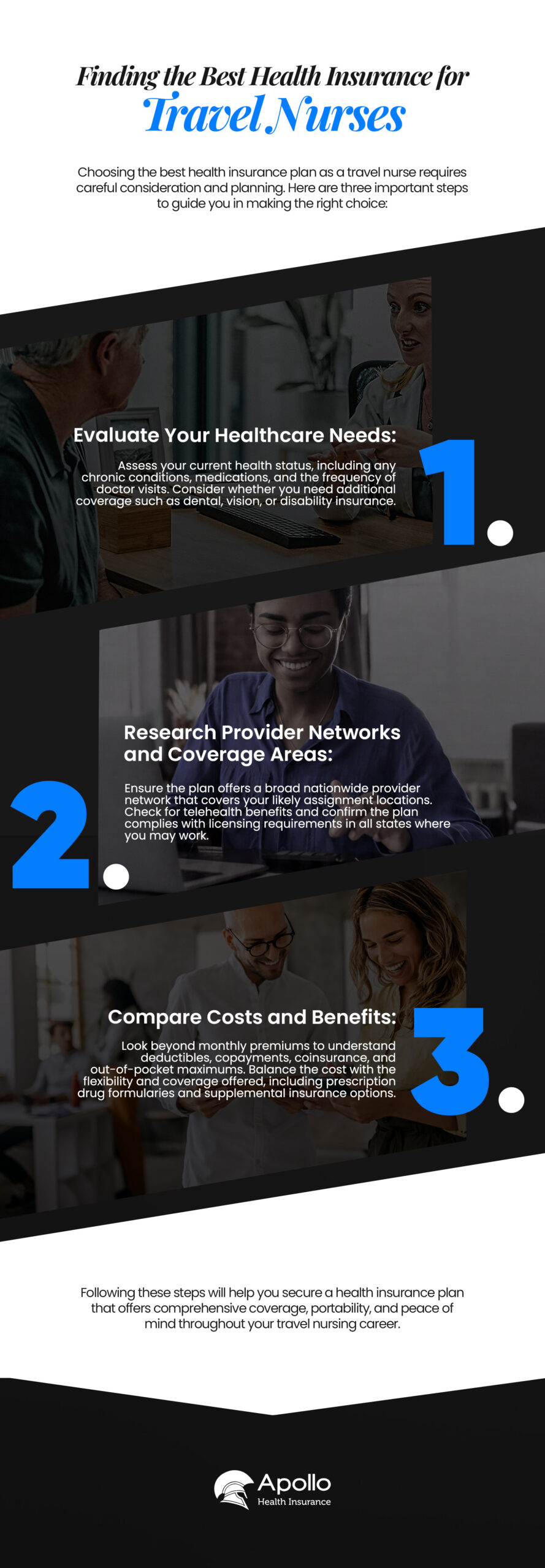
Choosing the right health insurance is a crucial step for travel nurses to ensure continuous, comprehensive coverage across multiple states and assignments. Prioritizing plans with nationwide provider networks, flexible coverage options, and benefits like telehealth can significantly enhance a travel nurse’s healthcare experience. Apollo Health Insurance specializes in helping travel nurses navigate these complex choices by offering expert guidance and access to tailored insurance plans that fit their unique needs and lifestyles. With Apollo’s support, travel nurses can secure reliable health insurance coverage that travels with them, providing peace of mind and allowing them to focus on their rewarding careers.
What is travel nurse health insurance?
Travel nurse health insurance is a specialized form of health coverage tailored to meet the unique demands of nurses who take on temporary assignments in various locations, often spanning multiple states.
Can I keep my agency health insurance if I switch to a different travel nurse agency?
Employer sponsored plans are tied to that specific agency’s group policy, so coverage usually ends shortly after your last day worked. When you change agencies or switch agencies altogether, you lose that plan. From there, you can elect COBRA to continue the same coverage (at full cost), enroll in a marketplace plan during a special enrollment period, or pick up your new agency’s insurance coverage instead.
What state should I use as my residence when shopping for ACA Marketplace plans?
Travel nurses generally use their tax home or permanent residence for Marketplace enrollment, not the temporary assignment address. Keep documentation-voter registration, driver’s license, mailing address-consistent for both tax and insurance purposes. Changing your permanent address is itself a qualifying life event that may trigger a special enrollment period.
How far in advance should I set up new coverage before a contract starts or ends?
Start the process 30 to 45 days before a known contract end date or start date. This window accounts for enrollment paperwork, ID card issuance, and coordination of start and end dates. If you anticipate needing to compare plans from multiple insurance providers or consult an insurance broker, give yourself even more lead time to avoid rushing into a plan that doesn’t fit your health concerns or geographic needs.

I'm a Marketing Professional focused on innovation and technological advancement, which fuel my mission to empower businesses in forging meaningful connections with their target audiences.