
 816-400-4477


Have you ever wondered how travel nurses manage health insurance when they're constantly on the move? Unlike nurses who work in one place, travel nurses face real questions about switching states, gaps between contracts, and network access — here's what to check before you enroll.
The short version
Travel nurse health insurance needs to solve for portability first. Confirm your plan's effective date and any waiting period before a new assignment, ask your agency directly how long coverage lasts after a contract ends and whether a grace period exists, understand that switching agencies typically means losing your current group plan, and check network coverage in your next assignment's specific state or region. Health sharing plans and short-term coverage can bridge gaps, but neither carries the same guarantees as ACA-compliant insurance. Starting the comparison 30 to 45 days before a known contract transition, rather than after coverage lapses, is what actually prevents a gap.
Source: HealthCare.gov Special Enrollment Period rules.
What is travel nurse health insurance?
Travel nurse health insurance is a specialized form of health coverage tailored to meet the unique demands of nurses who take on temporary assignments in various locations, often spanning multiple states. Unlike traditional health insurance, which is typically linked to a single employer or geographic area, travel nurse health insurance emphasizes portability, flexibility, and broad network access. This ensures that nurses can access in-network care regardless of where their assignments lead them.
These plans feature nationwide or multi-state provider networks, accommodating the frequent relocations typical of travel nursing. They are designed to provide continuous coverage, minimizing gaps between assignments to protect nurses during transitions. Travel nurse health insurance also offers flexible plan options, allowing nurses to balance cost with comprehensive benefits according to their individual needs.

Core health insurance options for travel nurses
Travel nurses generally have several health insurance options: agency-provided health insurance (employer-sponsored plans), individual plans purchased through the ACA Marketplace or state exchanges, private plans bought through specialized insurance brokers, and bridge solutions like short-term health insurance.
What to look for will differ depending on whether you rely primarily on an agency plan or an individual health insurance plan. Many travel nurses mix options over a calendar year, using an agency plan during long contracts and switching to a Marketplace plan when taking extended time off. Understanding these plan options sets the stage for every comparison that follows.
Travel nurses may also consider health sharing plans as an alternative to traditional health insurance. Health sharing plans are cooperative arrangements where members contribute monthly shares to cover each other's eligible medical expenses, rather than paying premiums to an insurance company. These plans often emphasize community support, shared values, and cost savings, making them appealing for travel nurses who seek flexible, affordable coverage.
Health sharing plans for travel nurses
Health sharing plans offer an alternative for travel nurses seeking flexible and affordable healthcare coverage. Unlike traditional insurance, these plans operate on a cooperative model where members share medical expenses, fostering a sense of community and shared responsibility. This structure often results in lower monthly costs and greater adaptability, making health sharing plans particularly well-suited for travel nurses who frequently move between assignments and states.
It's worth understanding that health sharing plans are not legally regulated insurance contracts. They aren't required to guarantee payment of a claim, aren't required to cover pre-existing conditions, and aren't subject to the same state insurance oversight as an ACA-compliant plan. For a travel nurse specifically, this distinction matters because a serious injury or illness on assignment, far from home, is exactly the scenario where a guaranteed, regulated payment obligation matters most. A health sharing plan can be a reasonable fit for a healthy nurse comfortable with that tradeoff, but it's worth going in with eyes open about what's actually guaranteed and what isn't.
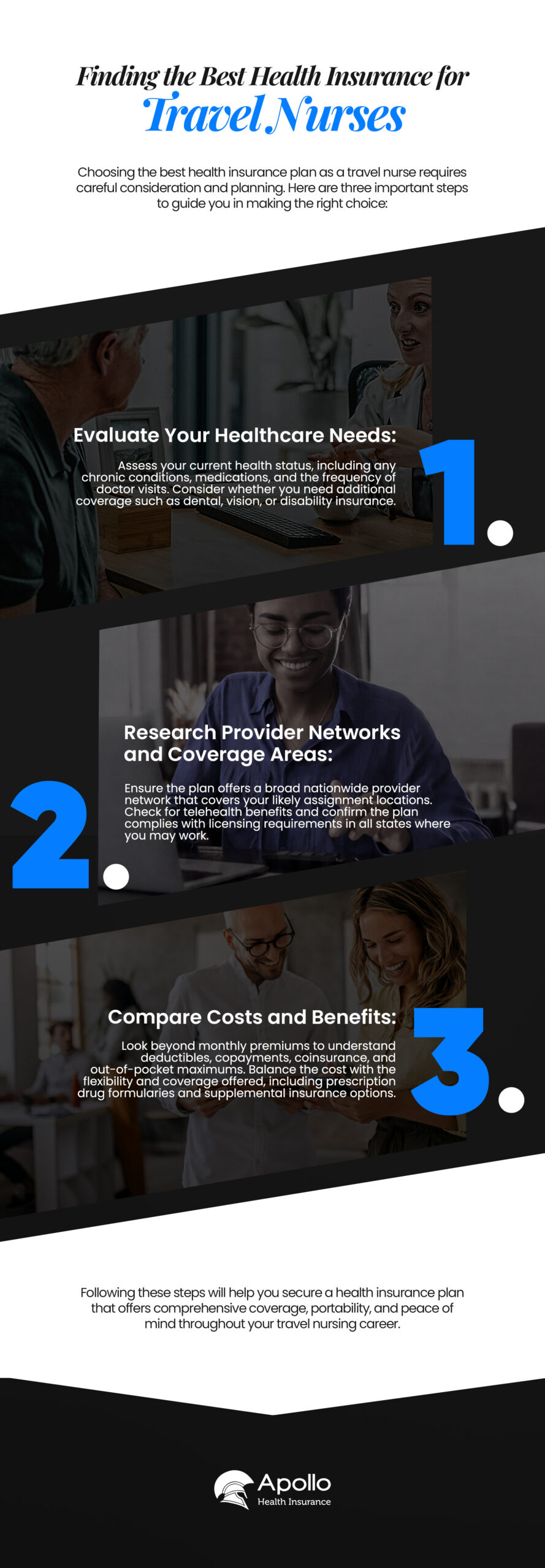
What to check before you enroll
Most travel nursing agencies offer employer-sponsored health insurance options, typically including medical coverage with dental and vision benefits available as add-ons. These plans often kick in after a waiting period of 1 to 30 days. However, some agencies only provide health insurance, excluding vision and dental from the package entirely.
Before enrolling, check these key considerations:
- Effective date: Does coverage start day one, or after a 30-day waiting period?
- Between-assignment continuity: Agency-sponsored plans may not cover gaps between assignments. Gaps over 14 to 30 days may result in loss of agency coverage.
- Switching agencies: When you change agencies, you typically lose the group plan, since coverage is tied to that specific employer's policy.
- Network limitations: Agency-sponsored insurance may have limited coverage outside assigned areas, which can leave you facing out-of-network care costs if your next assignment is in a different region.
Coverage between assignments and during life changes
Avoiding gaps in health insurance coverage is critical for financial protection and uninterrupted access to care. Continuous coverage between assignments is essential, and agency-sponsored insurance may leave nurses uninsured during extended breaks between contracts.
Ask your agency directly:
- How long does coverage continue after a contract ends?
- Is there a 14- to 30-day grace period?
- Can you keep coverage when switching internally to a new assignment?
A qualifying life event such as loss of agency coverage, moving to a new state, or a major family change opens a special enrollment window. ACA plans allow enrollment within 60 days of a qualifying life event, so you don't have to wait for the annual Open Enrollment Period.

Supplemental coverage: dental, vision, disability, and more
Many health insurance plans do not include dental coverage for adults, and vision coverage is not considered an essential health benefit for adults under the ACA. Plans should include medical emergency coverage during travel and may also offer dental and vision benefits, but don't assume they will.
When should travel nurses add supplemental insurance options?
- Dental: If you expect major work, such as crowns or root canals, or frequent cleanings, a standalone dental plan is worth the cost.
- Vision: If you depend on corrective lenses or need annual eye exams, consider vision benefits as a separate policy.
- Hospital indemnity, accident, and critical illness: Supplemental insurance can offset high out-of-pocket costs from primary plans through fixed cash payments during hospitalization or serious events, helping cover a high deductible.
For a travel nurse specifically, disability coverage deserves a closer look than it might for someone in a single fixed job. Travel nursing income is entirely contract-based, so an injury or illness that prevents you from working doesn't just interrupt a paycheck the way it might for a salaried employee with paid leave; it can end the contract itself. Checking whether your agency offers short-term disability coverage, and understanding exactly how a gap in physical capability would affect both your income and your health coverage, is worth doing before you need it rather than after.
Your residence address and enrollment timing
Travel nurses generally use their tax home or permanent residence for Marketplace enrollment, not the temporary assignment address. Keep documentation, such as voter registration, driver's license, and mailing address, consistent for both tax and insurance purposes. Changing your permanent address is itself a qualifying life event that may trigger a special enrollment period.
This consistency matters beyond just insurance paperwork. Using a temporary assignment address for one purpose and your actual tax home for another can create confusion during subsidy verification or tax filing, since both processes generally expect your reported address to match your actual permanent residence. Keeping every piece of official documentation aligned to the same address from the start avoids having to untangle a mismatch later.
Start the process 30 to 45 days before a known contract end date or start date. This window accounts for enrollment paperwork, ID card issuance, and coordination of start and end dates. If you anticipate needing to compare plans from multiple insurance providers or consult an insurance broker, give yourself even more lead time to avoid rushing into a plan that doesn't fit your health concerns or geographic needs.
A quick checklist
- Confirm your current plan's exact effective date and any waiting period for a new assignment.
- Ask your agency directly how long coverage continues after a contract ends, and whether there's a grace period.
- Confirm whether switching agencies actually means losing your current group plan.
- Check your plan's network coverage in the specific state or region of your next assignment.
- Decide whether dental, vision, or disability coverage needs to be added separately.
- Use your consistent tax home address for Marketplace enrollment, not a temporary assignment address.
- Start comparing new coverage 30 to 45 days before a known contract transition, not after coverage has already lapsed.
For the authoritative federal source on Special Enrollment Period rules that apply after a qualifying life event, HealthCare.gov confirms current timelines and qualifying events directly.
Common questions from travel nurses
Have a question that isn't answered below? Our full health insurance FAQ page covers more, and our blog has deeper guides on specific coverage topics.
What is travel nurse health insurance?
Can I keep my agency health insurance if I switch to a different travel nurse agency?
What state should I use as my residence when shopping for ACA Marketplace plans?
How far in advance should I set up new coverage before a contract starts or ends?
Are health sharing plans a good fit for a travel nurse?
Does it cost more to use a broker to compare travel nurse insurance options?
Let's make sure your coverage travels with you. At no cost.
An Apollo agent can compare your agency plan against Marketplace and short-term options, confirm network coverage for your next assignment, and help you avoid a gap between contracts. Broker services are free to you.
Explore individual health insurance, or learn more about our licensed advisors.
Disclaimer: This guide is general educational information about health insurance for travel nurses and is not insurance, tax, or legal advice. Plan rules, agency benefits, and enrollment deadlines vary by employer, state, and individual circumstances. Verify current details with HealthCare.gov, your specific agency's benefits documentation, or a licensed Apollo Health Insurance agent before making a coverage decision. Apollo Health Insurance is a licensed insurance brokerage; we are not affiliated with the federal government or any state agency.

I am a professional content writer specializing in the health insurance field. My work primarily focuses on simplifying the complexities of healthcare coverage, aiming to provide clarity and insight into an often confusing subject. Empowering people to make informed decisions about their well-being is my passion. At Apollo Health Insurance, we share that commitment. Apollo Health Insurance stands at the forefront of securing the best healthcare coverage for individuals, ensuring affordability without compromising on quality.